
Block Blast Tips and Tricks
HungryStudioUpdated
YesterdaySize
231 MBVersion
9.5.2Requirements
Android 6.0 and upDownloads
500,000,000+ Get it on

Description
⚡ Key Takeaways
- The center of the board is your most valuable real estate — protect it above everything else.Block Blast Tips and Tricks toBlock Blast Tips and Tricks to
- Combos are not luck. They’re the result of deliberate piece placement planned two to three moves ahead.
- Clearing two or more rows and columns simultaneously multiplies your score far beyond what single clears can achieve.
- The biggest mistake players make is placing pieces where they fit rather than where they’re needed.
- Board management — not speed — is the single skill that separates average players from high scorers.
Table of Contents
- Block Blast
- Board Management: The Foundation of Every High Score
- How to Plan Ahead and Stop Reacting to Pieces
- Combo Moves Explained — and How to Set Them Up on Purpose
- The Scoring System Decoded
- Common Mistakes That Are Silently Killing Your Score
- Advanced Block Blast Strategies for Serious Players
- Frequently Asked Questions
- Final Thoughts
Over 50 million people have downloaded Block Blast — and most of them are stuck making the same three mistakes over and over again. They’re placing pieces fast, filling gaps wherever they appear, and then watching their board spiral into an unplayable mess by round forty. Sound familiar?
The frustrating part is that Block Blast looks deceptively simple. Drag pieces, fill rows, clear lines. That’s the whole game, right? Wrong. Block Blast tips and tricks that actually work aren’t about reflexes or luck — they’re about spatial thinking, deliberate placement, and understanding a scoring system that rewards patience over speed.
This guide covers everything: board control, combo theory, scoring mechanics, common traps, and the advanced techniques that top players use to push scores into the millions. Whether you’re stuck at a frustrating plateau or just starting out and want to build the right habits from day one, what follows will change how you play.
What Block Blast Actually Rewards (It’s Not What You Think)
Most players assume Block Blast rewards fast thinking. Get the piece, find a gap, drop it in, move on. The problem with that approach is that it treats every placement as an isolated decision — and Block Blast punishes isolated thinking with a slow, painful board death.
What the game actually rewards is pattern recognition and delayed gratification. The players hitting the highest scores aren’t the fastest ones. They’re the ones who look at an incoming piece and immediately think about what that placement sets up three moves from now. That mental shift — from reactive to proactive — is where everything changes.
Think of it like chess. A beginner moves the piece that seems best right now. An experienced player moves the piece that makes the board better for the next five turns. Block Blast operates on exactly that logic. Every piece you place is either building toward something or slowly making your situation harder to escape.
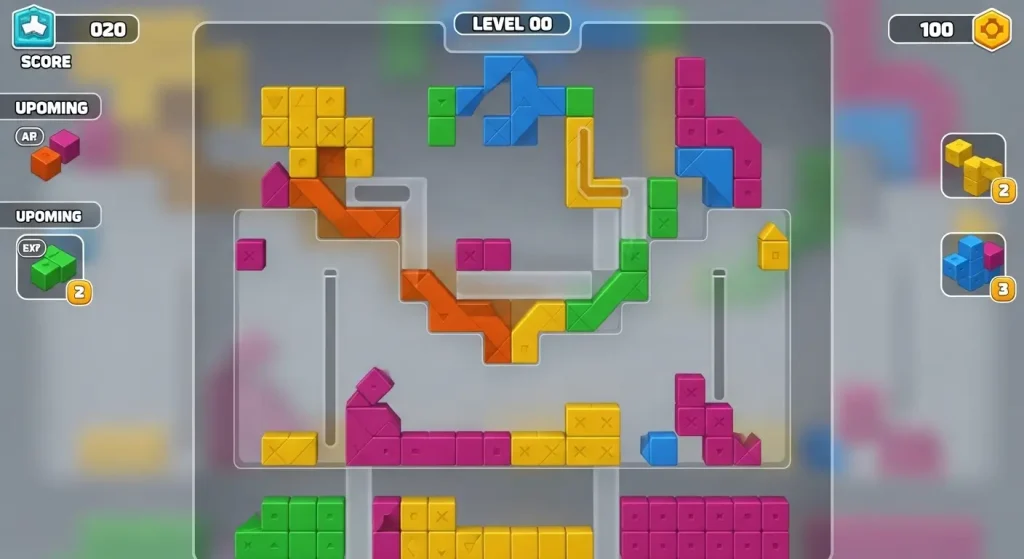
Board Management: The Foundation of Every High Score
Board management is the single most important skill in Block Blast, and it’s the one thing almost no casual guide talks about properly. Your board is not just a place to put pieces — it’s a resource you’re either spending carefully or burning through recklessly.
The golden rule of board management is this: always keep your board as flat and even as possible. Tall towers and awkward gaps are the enemy. When one area of your board gets significantly higher than the rest, incoming pieces start becoming impossible to place without making things worse. That’s when the cascade of bad decisions starts, and it almost never recovers.
The center of the board matters more than the edges. Here’s why. When a large L-shaped or T-shaped piece comes in, you need flexible space to rotate and fit it comfortably. The center gives you options in all directions. The edges lock you into one or two placement choices. Players who habitually push pieces to the edges of the board are essentially reducing their future options with every move.
Here’s what healthy board management looks like in practice:
- Keep the left-right height difference across your board under three rows at all times
- Never let a single column reach the top half of the board while others sit near the bottom
- Think of the board as a flat surface you’re trying to keep level — not a container you’re filling up
- When you get a long horizontal piece, resist the urge to drop it at the top — look for where it creates the most clearing potential lower down
- After every clear, reassess the entire board shape before placing the next piece
Also Read: GTA V Mobile APK for Android – Free download
Why Flat Boards Score Higher
A flat board doesn’t just look cleaner — it actually creates more clearing opportunities per incoming piece. When your board is level, almost every piece that arrives has multiple valid placements that can contribute to a line clear. When your board is uneven, pieces start getting forced into corners or awkward spots that contribute to nothing and just raise your overall height.
The math works out significantly in your favor the flatter you play. A player maintaining a flat board will clear two to three times more lines per hundred pieces than a player filling gaps reactively. And since scoring scales with the number of simultaneous clears, those extra line clears compound into dramatically higher scores over a full session.
How to Plan Ahead and Stop Reacting to Pieces
Reactive play is the silent killer of Block Blast sessions. You’re looking at the piece you have, finding somewhere it fits, dropping it, and then looking at the next piece. That cycle feels natural and even efficient — but it’s the fastest way to box yourself into an unwinnable board state.
Planning ahead in Block Blast means always thinking about the next two to three pieces, not just the current one. The game shows you upcoming pieces before they become active. Use that preview. Before you place anything, ask yourself: where does this piece need to go so that the next piece also has a good home?
This sounds complicated, but it becomes instinctive quickly. Start with just one piece of lookahead. Before placing the current piece, glance at the next one and make sure your placement doesn’t block a natural home for it. Once that feels easy, extend your awareness to two pieces ahead. Within a few sessions, you’ll naturally think in sequences rather than individual moves.
💡 Pro Tip: When you receive a large or awkward piece — like a 3×2 block or an irregular L-shape — place it first in your mental planning even before you look at your current piece. Work backwards. Figure out where the hard piece needs to go, then position your current piece to set up that landing zone.
The other critical planning habit is building toward specific line clears deliberately. Instead of clearing lines as they happen naturally, train yourself to see incomplete rows and actively route incoming pieces to finish them. This is the difference between a player who clears lines reactively and a player who engineers clearing opportunities — and the scoring gap between those two approaches is enormous.
Combo Moves Explained — and How to Set Them Up on Purpose
Combos in Block Blast are where the real scoring happens. A combo occurs when a single piece placement clears multiple rows, multiple columns, or both simultaneously. The score multiplier from simultaneous clears is significantly higher than the sum of what each individual clear would be worth — which means engineering combos is the fastest path to a high score.
Here’s what most players get wrong about combos: they think they’re accidental. They happen to clear two rows at once and feel lucky. But combos are entirely engineered. Every high-scoring player is actively setting up combo conditions several moves in advance.
The anatomy of a great combo setup:
- Identify two or three rows that are almost complete — missing just one or two cells each
- Route incoming pieces so they fill those missing cells without disturbing the rows you’re building
- When the piece arrives that completes all three rows simultaneously, drop it and watch the multiplied score land
The hardest part of combo building is patience. You’ll have moments where you could clear one row right now, but waiting one or two more moves would let you clear three rows simultaneously for five times the score. Taking the single clear feels satisfying in the moment. Waiting for the triple clear is the smarter play.
Column combos are underused by most players. Most people focus on clearing horizontal rows because that’s the most visually obvious clearing mechanic. But vertical column clears work exactly the same way, score just as well, and are easier to set up with tall narrow pieces. A player who actively builds toward both row and column clears simultaneously is operating at a different level than someone focusing on rows alone.
Here’s a quick framework for combo planning:
- Scan the board after every clear and identify your two most nearly-complete rows
- Also identify your two most nearly-complete columns
- Look for incoming pieces that can contribute to both simultaneously
- Prioritize placements that advance multiple clearing goals over placements that advance just one
- When a piece offers no obvious clearing contribution, place it where it disrupts your board the least
The Scoring System Decoded
Understanding exactly how Block Blast calculates your score is not just interesting — it’s genuinely useful information that should change how you play. Most players have a vague sense that clearing more is better, but the actual multiplier system rewards specific behaviors dramatically more than others.
Single line clears — clearing exactly one row or one column — give you a base score. It’s fine. It’s progress. But it’s the least efficient use of your board opportunities.
Double clears — two rows, two columns, or one of each simultaneously — give you a multiplier that’s noticeably higher than two single clears combined. This is where most intermediate players operate, and it’s a solid place to be.
Triple and quadruple clears — three or more rows and columns cleared in a single piece placement — is where the score explodes. The multipliers at this level are disproportionately high relative to the effort required to set them up. A player who engineers one quadruple clear earns more points from that single placement than most players earn from ten individual single clears.
📌 Quick Fact: Clearing three rows and two columns simultaneously in a single move can score anywhere from eight to twelve times what three separate single clears would earn. That scoring gap is why combo planning isn’t optional for anyone serious about their high score — it’s the whole game.
Board clear bonuses are the ultimate scoring event. When you clear the entire board in one placement or sequence, the bonus score is substantial. Achieving a full board clear requires exceptional planning over many moves — essentially managing your board shape so tightly that a single large piece can complete everything remaining. It’s rare, but when it happens, it moves the score needle more than almost any other event in the game.
Common Mistakes That Are Silently Killing Your Score
Every Block Blast player has a mistake they make habitually — something they do on autopilot that slowly destroys their board without them realizing it. Identifying and eliminating your personal bad habit is often the single fastest way to improve your score.
Mistake 1: Filling gaps instead of building structure The most common mistake in Block Blast is treating every gap as something that needs to be filled immediately. When you see an empty space, the instinct is to plug it. But not all gaps are problems — some gaps are future opportunities. Filling a gap in the wrong spot blocks a clearing lane you were building toward, forcing you to reroute your entire strategy.
Mistake 2: Ignoring the board edges The edges of the board — particularly the corners — are natural trap zones. Pieces placed in corners are hard to clear because they require both a complete row and a complete column to be removed. Players who consistently push pieces into corners find those corner pieces becoming permanent fixtures that gradually limit their options.
Mistake 3: Chasing a single row clear instead of waiting for combos This is the patience problem. You’re three cells away from clearing a row. A piece comes in that could finish it. You drop it immediately — and miss the fact that waiting one more move would have let you clear that row plus two columns simultaneously for a quadruple combo. Train yourself to evaluate the combo potential of every near-complete line before clearing it immediately.
Mistake 4: Not adjusting strategy when the board gets difficult When the board gets messy — multiple uneven areas, isolated gaps, towers forming — most players panic and try to continue their normal strategy. The right response is a controlled reset. Accept that you’re in a survival phase temporarily, focus entirely on flattening the board, and delay scoring ambitions until you’ve recovered a manageable board shape.
Mistake 5: Placing pieces too quickly Speed is the enemy of strategy in Block Blast. There’s no time limit. There’s no penalty for pausing. Taking an extra three seconds to evaluate each placement costs you nothing and gives you the mental space to spot the better move. Players who slow down almost universally improve their scores within a session or two.
Advanced Block Blast Strategies for Serious Players
Once you’ve got the fundamentals solid — flat boards, combo planning, forward thinking — there’s a next level of play that separates good players from exceptional ones. These strategies aren’t complicated, but they require consistent application to become instinctive.
The T-Tetromino Priority Rule
T-shaped pieces and L-shaped pieces are the most challenging pieces in Block Blast because they’re irregular. They need specific surrounding shapes to land cleanly without creating awkward gaps. The advanced strategy is to never place a T or L piece without first identifying exactly what gap it will fill and what the board looks like after.
Most players grab a T-piece, scan for somewhere it fits, and drop it. The better approach: look at the T-piece, identify the ideal landing zone for it on your current board, then evaluate whether that placement is good or just acceptable. If it’s just acceptable, consider whether there’s a better nearby position that creates more future flexibility.
Zone Clearing — Managing the Board in Sectors
High-level Block Blast players mentally divide the board into zones — typically left third, center third, and right third. They actively manage which zones are getting crowded and route incoming pieces to balance the zones against each other. When the left zone starts getting taller, they deliberately route the next several pieces leftward to bring it back into balance.
This zone awareness prevents the slow board creep that kills most sessions — where one area keeps getting pieces because it’s convenient until suddenly it’s dangerously tall while the other side sits empty and wasted.
The Sacrifice Play
Sometimes the best move is the one that hurts a little now to save the board later. A sacrifice play means placing a piece in a suboptimal position — one that scores nothing and fills a useful space — because the alternative is forcing an even worse placement in a more critical area.
Recognizing when a sacrifice play is the right call requires reading the board well. If your center is getting tight and an awkward piece arrives, it’s sometimes better to sacrifice a corner position to protect the center than to awkwardly force the piece into the center and create a problem that compounds over the next five moves.
Reading Incoming Pieces as a System
Advanced players don’t look at pieces individually. They look at the sequence as a system. When three pieces appear in the upcoming queue, the question isn’t “where does this piece go?” — it’s “what arrangement of these three pieces creates the best board state after all three are placed?”
This system thinking means sometimes placing piece three’s ideal location before placing piece one — because understanding where everything ends up lets you reverse-engineer the optimal sequence. It sounds mentally intensive, and it is at first. But it becomes natural, and the scoring improvement is significant.
Handling Difficult Piece Combinations
Every Block Blast player has piece combinations that consistently cause them problems. Maybe it’s back-to-back large square pieces when the board is half-full. Maybe it’s receiving three tall vertical pieces when your columns are already close to the top. The advanced skill is recognizing your personal difficult combinations and having a predetermined response to them.
The next time you hit a board-killing sequence, pause and analyze exactly what went wrong. Was it the pieces themselves, or was your board shape not prepared to receive them? Usually it’s the latter. The pieces you receive are random, but the board you’ve built is entirely your responsibility.
Frequently Asked Questions
Q: How do you get a high score in Block Blast?
A: The fastest path to a high score in Block Blast is mastering combo clears rather than chasing individual line clears. Set up situations where a single piece placement clears three or more rows and columns simultaneously — the score multipliers from multi-clears are dramatically higher than single clears. Combined with flat board management, consistent combo engineering will push your score well beyond what reactive play ever achieves. Patience matters more than speed. There’s no time limit, so use it.
Q: What is the best strategy for Block Blast?
A: The best overall strategy combines three things: keeping your board as flat and even as possible, planning two to three moves ahead rather than reacting to individual pieces, and actively building toward multi-line combo clears instead of clearing one row at a time. Protect the center of the board, avoid pushing pieces into corners, and treat every placement as a setup for the next move rather than just a solution to the current piece. That mindset shift is what separates average players from high scorers.
Q: How do you clear the board in Block Blast?
A: A full board clear requires long-term board management that leaves the board in a very specific near-complete state — where the majority of rows and columns are missing just one or two cells, so a large incoming piece can complete everything simultaneously. It’s not something you can engineer quickly. It develops over many careful moves where every piece placement is contributing to a converging pattern. Full board clears are rare but happen naturally for players who consistently maintain flat, well-managed boards.
Q: Why does Block Blast get harder as you progress?
A: Block Blast doesn’t necessarily get harder in terms of piece complexity — the pieces available stay consistent. What makes later stages feel harder is that your board accumulates the consequence of every imperfect placement you’ve made. Small inefficiencies compound over time. A slightly awkward piece placement in round twenty becomes a structural board problem by round sixty. The players who maintain high performance throughout long sessions are the ones whose early placements are clean enough that the compounding effect stays manageable.
Q: How do combos work in Block Blast?
A: A combo in Block Blast occurs when a single piece placement clears more than one row, more than one column, or both rows and columns in the same move. The game applies a multiplier to your score based on how many lines clear simultaneously — and that multiplier increases significantly with each additional line cleared. Clearing two rows and two columns at once doesn’t just add four single-clear scores together; it multiplies them. That’s why deliberately building toward multi-clear combo positions is the cornerstone of any high-score strategy.
Final Thoughts
Block Blast rewards the players who slow down, think ahead, and treat every piece as part of a larger pattern rather than an isolated problem to solve. The gap between a player who reacts and a player who plans isn’t talent — it’s habit. Build the habits covered here, and your score will improve whether you’re playing your first hundred games or your thousandth.
If any of these Block Blast tips and tricks clicked for you — especially the combo planning or board management sections — drop a comment below and share what changed in your game. And if you know someone who keeps complaining their Block Blast score is stuck, share this with them. Sometimes one insight is all it takes to break through a plateau and finally see what this game is really capable of.
What's new
- Bug fixes and performance improvements.
- We actively gather and analyze feedback to steer the improvements in our game. We're committed to bringing you the finest block puzzle gaming, coupled with an unparalleled playing experience.
Images


Video
Download links
How to install Block Blast Tips and Tricks APK?
1. Tap the downloaded Block Blast Tips and Tricks APK file.
2. Touch install.
3. Follow the steps on the screen.
Related apps





-
Recent Posts